
Radar Detector Testing
Do-It-Yourself Radar Detector Testing…It’s harder than it looks!
First Problem: Detectors hate each other – Every superheterodyne receiver—that includes all of today’s radar detectors—receives and transmits during normal operation. As you probably know, these detector signals sometimes set off other detectors. Out on the road, other detectors are the most common nuisance signal V1 has to deal with.
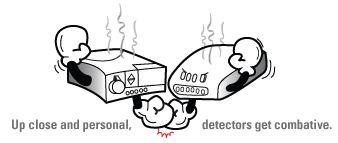
What’s not so obvious is this. Even if a detector isn’t set off by another one, its internal defense system may be affecting its radar sensitivity. This problem compounds when you bring two operating detectors into the same car. Up close, the transmitted signals become much stronger than a normal design would anticipate, and the weak signals that wouldn’t bother at normal distances can send the defense system into hyperdrive.
V1 inspects every signal it receives and decides, Is it really radar? Is it maybe radar? Is it not radar. But it isn’t designed to operate within a few feet of another detector, and we know of no other detector designed for that high-stress condition either.
Here’s the irony: If you put two detectors together and one of them seems sluggish, you might decide that one is inferior. In fact, it may have a superior defense system, and the detector that appears to work better may be a grotesque polluting transmitter.
It’s more trouble to test detectors by powering up one at a time, but it’s the only way to tell which is better at finding radar.
Second Problem: What if they don’t seem very different – Since all detectors warn when they go line of sight with the radar transmitter, they often sound their warnings well before you see the radar. But as I explain at length in Radar Detector Tests, the critical test of early warning is, What do you get “when the headlights are still beyond the hill?” The point here: To test meaningfully, you need to know the location of your radar. Are you really over the hill, or are you dipping in and out of line-of-sight as you approach. If you’re dipping, both detectors will seem very similar in their response.
Reliable measurements of early warning are rarely done in normal driving. I recommend this approach: find a false alarm (they don’t move on you). Go out of range, preferably beyond a rise in terrain. Then approach, and note where the alert begins. Test each detector separately. Make at least three runs for each. For different bands, find different false alarms.
Dipping Terrain
Car A is line-of-site with source, so alerts come easily, but down the hill at Car B, a strong detector will outperform a weak one.
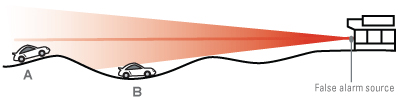
One caveat here: the typical false alarm is very weak compared to real radar, so range will be short and the difference between detectors will be compressed. Expect much larger differences against traffic radar.
Yes, this is a lot of trouble. But you’ll have a result you can trust.

Michael D Valentine
President – Valentine Research